Sep 10,2026
Dehydrated Red Peppers: Quality, Processing and Buying Insights
For food manufacturers, dehydrated red peppers are more than a colourful garnish. They carry flavour, shelf-life stability and the confidence of a supply chain you can trace.
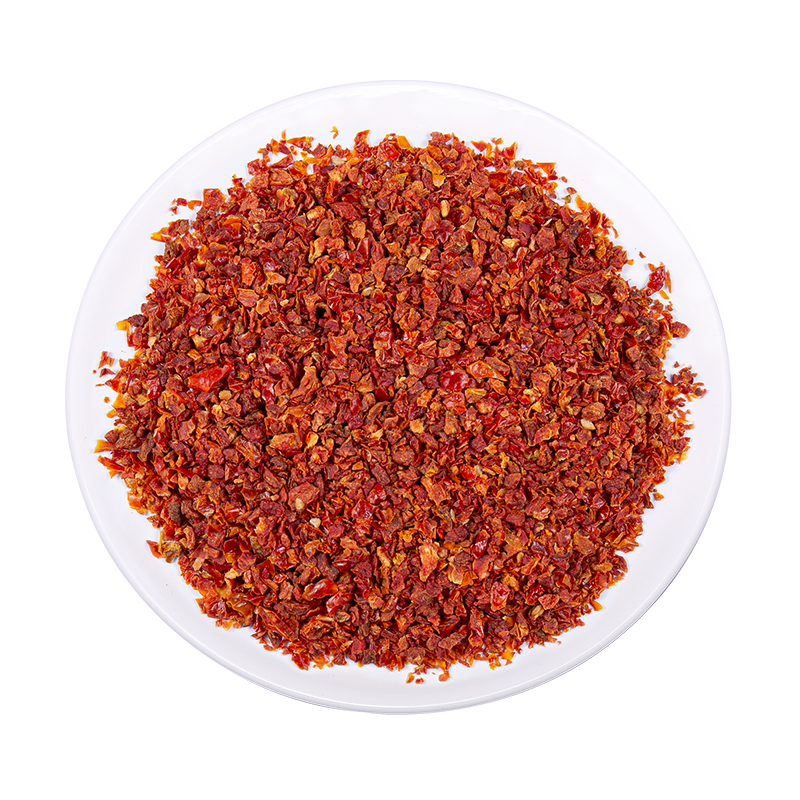
When a production manager opens a 10 kg carton of dehydrated red pepper flakes, the first thing they test is moisture content, not colour. A bright red batch that begins to clump or loses its sweet aroma has failed the only specification that matters: stability. The quality of dehydrated red peppers is decided long before the carton is sealed—during growing, washing, cutting, drying and screening.
This article looks at how commercial red pepper dehydration works, what to check before ordering, and why a supplier’s physical infrastructure is the real guarantee of consistency.
Why Food Manufacturers Choose Dehydrated Red Peppers
Fresh red peppers are mostly water. They are seasonal, labour-intensive to handle and expensive to transport. Dehydrating them removes roughly 85 to 90 percent of the original weight while concentrating natural sugars, capsanthin and vitamin C. In flake, granule or powder form, the ingredient can stay stable in a dry goods warehouse and still deliver colour and taste months later.
For product developers, the advantages are practical:
- No cold-chain dependency for storage
- Easier recipe standardisation across production sites
- Lower freight and storage costs per dose of flavour
- A consistent supply that is not tied to one harvest window
When suppliers manage raw material sourcing tightly, these benefits become even more predictable.
How Commercial Dehydration Works
The commercial process is deliberately gentle. Red peppers are washed, destemmed and cut to a uniform size. Depending on the specification, they may be blanched first to neutralise enzymes. They then pass through a hot-air dryer, where temperature is kept below a level that would damage colour or capsaicin. The goal is to remove moisture without turning the pepper into a brittle, flavourless shell.
If you want to understand the general production flow behind red peppers, it follows the same principles we described in our walkthrough of how dehydrated vegetables are made.
Good dehydration does not preserve the pepper; it preserves the field where it grew.
At our Inner Mongolia facility, the distance between field and dryer is short. Raw red pepper starts processing soon after harvest, which limits enzymatic activity and colour loss before drying.
Flakes, Granules or Powder: Form Matters
The form of dehydrated red pepper is not a cosmetic choice. It changes surface area, rehydration speed and how the ingredient behaves in a dry mix. Flakes are ideal for visible texture; granules blend easily; powder gives a smooth colour and flavour release.
| Parameter | Flakes | Granules | Powder |
|---|---|---|---|
| Moisture content | ≤ 6% | ≤ 5% | ≤ 5% |
| Water activity | ≤ 0.50 | ≤ 0.45 | ≤ 0.45 |
| Particle size | 8–20 mm | 1–3 mm | 80–100 mesh |
| Typical shelf life | 18 months | 24 months | 12 months |
Watch the particle-size distribution, not just the average size. If the range is too wide, fine particles can settle at the bottom of the packaging while coarser pieces remain on top, creating an inconsistent dose in each batch.
Quality Specifications That Protect Your Product
Before ordering, establish the critical control points: moisture content, water activity, particle size and colour. Moisture content determines weight value and caking risk. Water activity predicts microbial stability. Particle size affects dispersion and visual consistency.
Danger: A batch with water activity above 0.60 can develop mold even if the moisture content looks acceptable. Always request a certificate of analysis and verify the first shipment independently.
Uniform particle size is as important as chemical purity. A seasoning blend can look uneven if half the flakes become powder in transit. Reliable suppliers sieve after drying and monitor bulk density to keep bag weights and dosing behaviour consistent.
What a Credible Supplier Brings to the Table
The supplier’s manufacturing footprint matters more than the price per kilogram. A dehydrator located far from the growing area needs to receive red peppers still in a condition that makes sense for drying. Our company started in 2003 in Xinghua and later invested in a new facility in Bayannur, Inner Mongolia, specifically for peppers, tomatoes and other crops from northwest China. That proximity means raw red pepper can begin drying within a short window after harvest.
Info: The Bayannur facility is positioned as a full raw-material-to-finished-product base. By managing planting and field operations, the company reduces variability before the pepper enters the factory.
Certifications are the visible part of quality, but the invisible part is process design. BRC A+ certification, achieved in 2024, indicates a food safety culture that international food brands can rely on. When visiting or auditing a supplier, look for evidence that raw materials are inspected, metal detection is calibrated and drying times are recorded per batch.
Using Dehydrated Red Peppers in Food Products
In a recipe, dehydrated red pepper can be added directly to a dry seasoning mix or rehydrated in oil, water or stock. A typical flake can absorb three to four times its weight in liquid, which raises the water activity of the final sauce. You need to balance pH, preservative system and packaging accordingly.
Warning: If your target formulation has a water activity above 0.85, do not assume dehydrated red pepper will stay shelf-stable. Account for water migration and adjust your formulation.
Colour release is another consideration. If the pepper is added to a fat-based product, the orange-red oleoresin will slowly migrate into the oil. This can be desirable in a chilli oil, but may be disruptive in a pale cream sauce. Testing the finished product at the exact usage level is the only reliable way to set the specification.
Success: For meat marinades, granules often outperform flakes because they hydrate faster and spread more evenly without creating an inconsistent visual texture.
Final Consideration
Dehydrated red peppers earn their place in a formulation when every component can be verified. Set a moisture and water activity limit, agree on a particle-size range, and select a supplier whose production base is close to the source. These actions may seem simple, but they prevent the costly surprises that show up only after the carton is opened.